Sunday, January 29, 2012

Craft. Oh for goodness sake. #3

It's a way of doing things, isn't it? It's in the making. It's not, as such, a property of the made thing. It's not a style, or kind, of thing. So why look for it in the product? It's in the process.

Friday, January 27, 2012

Craft. Oh for goodness sake. #2

And now it's kinda kewl to put yourself on the outside of that old "craft" debate. You know the one: Does "craft" mean anything? Does it mean anything in the UK brewing "scene"? Can it mean anything specific to our industry / tradition? It has been going on for a while now.

But the alternative (that isn't an alternative), Huh , who cares, I know what I mean when I say "good". I know what I like. That's an asocial, narcissistic way of looking at things, isn't it? And to imply that anyone still engaged is dumb, well that's like: "Is that thing still happening? It's like so yesterday, I am so over that." Amusing in a teenager, but pitiable in a grown-up.

Sunday, January 15, 2012

Craft. Oh for goodness sake.

Ok then - a craft brewery is a small, independent producer of beer.
Why small? Because craft is NOT about mass-production.
Why independent? Because it's about the beer, and the brewers, not about the financial targets of the parent company.

What do I mean by small? Well, we're fortunate enough in the UK to have a definition for a small brewery: i.e. one that makes "Small Brewery Beer", i.e. less than 60,000 hectolitres of beer per year.

What do I mean by independent? That the brewery should be owned (mainly) by its management / workforce.

Update: This would have been a good place to suggest (as Boak & Bailey did), that "The brewers are the management".

But what does Craft mean? How about asking the V&A? http://www.vam.ac.uk/content/articles/w/what-is-craft/. Do they have a beer collection? Should they?

Update: Small-ness & Independence are necessary, but of course, not sufficient conditions for craft-ness.

Friday, December 16, 2011

Under Attack?

Apparently I'm guilty of "repeatedly espousing destructive policies" and am to be "attacked" for it. (Not really, just on the Twitter). Even though this charge does have rather the ring of "corrupting the youth and impiety" (hah!) I'd like to make my position as clear as I can.

I don't espouse any particular energy policy, "Carbon Tax", trading arrangement or whatever. I don't know enough about all the particular policies to have serious opinions on them. I'm pretty much in agreement with the "polluter pays" principle, and I accept the reality of "liberal democratic" government. At the same time, while not being simplistically anti-capitalist, I'm aware that capitalism doesn't necessarily well serve the general good. I know that national governments aren't world governments, but they are governments in the world.

I'm not convinced that taxation (per se) is necessarily bad for an economy. Perhaps some taxes are bad (counter-productive / above revenue maximising rates / squandered / etc).

I have (on the twitter) posted links to interesting documents on Carbon Emissions, Climate Change and what might be done about it. Most recently:
"Bridging Emissions Gap for 2C Target Do-able bit.ly/uJKBXS , but we couldn't be bothered. Sorry kids. Daddy broke the world."

(The reference is to a report by the United Nations Environment Programme)

The point I was trying to make is that it appears that the 2°C target is technically achievable; however, politically (even given the success(?) in Durban http://www.bbc.co.uk/news/science-environment-16124670) it looks a bit unlikely - to say the least.

Obviously, here at Stringers, we're interested in the Climate Change and Emissions thang. We're somewhat interested in Fossil Fuel Dependence, and stuff like that. We're very interested in Autonomy, which is why we we feel we should internalise our true energy costs, as far as possible, ourselves - hence our 100% renewably powered position (for which we pay a small premium). We don't wait for The Man to force us to do the Right Thing.

Anyhoo, the main point leveled against me (by @GreatHeckBrew), as far as I can figure it, is that
"carbon reduction policies of European governments are well intentioned but counterproductive. They increase global emissions"
ie. it's suggested that EU policies transfer emissions to the developing world, resulting in a net increase in Carbon emissions. The mechanism proposed seems to be that the burden of EU policies on EU based business impairs competitiveness, so dirty (less regulated) developing world industries gain an advantage and expand.

Now, to "prove" that EU policies leads to an overall transfer of emissions to the developing world (or as we might say, "Exports Emissions"), you'd need to, as a minimum, show two things:
  1. Emissions are exported (overall).
  2. This is due to EU policies.

I'm not aware that this has been done.

30 Dec 2011:
Right, nothing from my "attacker" (golly) so that's a "shut up" having failed to "put up" thing.

Friday, August 12, 2011

The Physics

Professor Branestawm called us into his workroom earlier today.
"See here!", he cried, indicating what appeared to be an old television set balanced precariously on top of what we first took to be an old refrigerator, but closer inspection revealed as a VAX 11/750. "The Internet!" he gesticulated at the screen, "The world wide web!".

And sure enough, the good professor was pointing at a shaky image of Hardknott Dave's blog.

"Very good Professor..." and with placatory smiles, we edged back towards the door.

"No, no," he laughed, "I'm quite familiar with your Internet nonsense, thank you very much. I merely wished to draw your attention to this debate about cooling!"

"See here", he continued, "one of these Internet characters holds that beer lines should be cooled along their length, while another proposes that the cellar temperature should be lowered during the warmer part of the year."

"Internet characters?", I burst out, "Professor, those are real people you're talking about!"

"Indeed?" He looked over one of his many pairs of spectacles, "So you say. I should like to see you prove it. However, that's for another day. Shall I continue?"

"Please, professor, do." We made ourselves as comfortable as possible on piles of old DEC manuals. Mine had a scrap of paper on top which bore only the words "BELL END". I held it up. "Professor? Is this important?"

"Ah, thank you." he took it from me and forced it into an already packed drawer, which he closed with a few smart mallet blows. "That's the last part of my halting problem proof. Marvelous things, these computers".
"Now see here," he went on, and once again pointed at the screen, "If we cool the beer line directly, we can remove the heat picked up along it's length."
He laughed, "Or to put it another way, we can add coolth to cancel out the warmth".

"Coolth, Professor?", once again, he'd lost us.

"Certainly!" And he made his way to the door where he flicked a switch. Instantly, the room was plunged into darkness. His voice came out of the gloom. "Behold! The electric dark bulb!"

"Professor!" I exclaimed. The workroom was dangerous enough in the light, stumbling around in the dark might be lethal. "For goodness sake turn it on!"

"Off, you mean", he laughed. "Although, oddly, it consumes far more power off than on!". But he relented, and continued. "I'm pretty sure that it requires less coolth to keep a beer line at the right temperature than to super-cool a pub cellar. Indeed, if we do cool the cellar below the beer serving temperature, we're using the beer itself as a coolth transfer fluid, in an uninsulated tube, to lower the temperature of the dispense equipment."

He smiled, "By coolth, of course, I refer to the power required (running the chillers, or air-con, or cellar coolers) in order to remove the excess heat and push it out of the building."

He opened the front of the old VAX 11/750 and revealed a mess of wires, some brazed copper tubing, a bare motherboard and some bottles. He got a beer for each of us.
"I've converted it into a fridge, that's an Intel Core i7, and I'm overclocking it big style".

"Bottoms up Professor!"

Tuesday, August 09, 2011

Craft, Real Ale. Whatever. I just want to buy some beer.

Marketers, and all you students of the market, are aware of what's been called the "Pretty Good problem". Time was, choice was a real issue for the consumer. We were, once, confronted by a heap of shoddy, sub-standard, adulterated and unsafe products, with a few quality items offering honest value for money. The problem then was to identify those valuable items and avoid being tricked into spending our money on crap.

Nowadays, in the beer market, as elsewhere, the problem is different - most stuff is "pretty good". I'm not saying that none of it is rubbish, or that some of it isn't excellent, but most of it offers a reasonable return for my spend. These are great times for the beer drinker. But there is such a lot of it. All those competing products - how do I choose? If I can't choose, how will I buy? This potential choice paralysis is a real problem for me, and disaster for the vendor.

Anyway, here I am, lost in the supermarket (or wherever), so much choice, so little difference. Most products are invisible, they're so soon boring, unremarkable. I walk right past them without seeing them.

Now I can only see the purple cows. Everything else is a familiar blur.

So, how do vendors make me see their stuff? How to make it stand out? If the product isn't essentially remarkable, how do they lend it a quality that makes it different, more... more?

It's worth remembering that we seem to be much more sensitive to distinction based on a unique value for a single property rather than on a unique combination of properties. So we'll typically be told a simple story rather than given a nuanced analysis of the product's advantages.

In order to increase product salience vendors often use forms of what you might call "oppositional marketing". I guess this works (at least partly) because we're all highly responsive to signifiers of conflict - I'm sure that there are good evolutionary reasons for that. At its simplest, this can be as crass as "knocking copy": "Product B is crap (here's how) - buy Product A!".


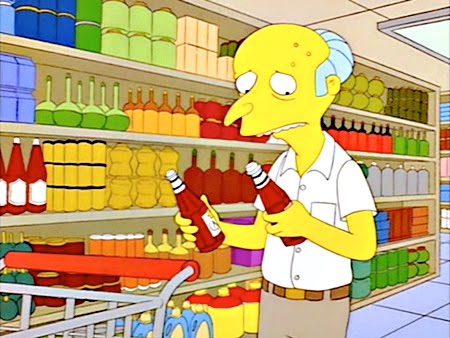
Or we might see the creation of simple, clear, but essentially false dichotomies. The vendor hopes to streamline our choice-making. Traditional v. progressive, Craft v. Real Ale, Catsup v. Ketchup

We see this when the vendor tries to place the product on one side or other of some widely recognised disjuncture. This is the basis for products being associated with generational Bullshit. Sometimes this disjuncture is (if not created) actively promoted by the vendor. Hence: Real Ale = old/bearded/mature/sensible drinker (Y-Fronts). Craft = young and hip and has a daft haircut/hat/beard/shoes (Boxers).

Genuine, but not of themselves particularly significant, distinctions amongst products are subsumed in a construction and reinforcing of ideology.

What do we get from this? Well apart from an easing of the pain of choice (which I'll come back to), we get some real positive value from the branding effort. Not in the sense that these positioned products are better, but the branding itself can be valuable. We can use the product we've chosen to send signals about ourselves - sometimes to ourselves.


We buy a product that's young, urban, sophisticated, because we are young, urban, sophisticated. We wish. We buy products that are "difficult" (says the vendor) to demonstrate our discernment. We join the community of the brand. The product is the badge of our membership. It may be that this sense of community is worth far more to us than any simply product derived utility .

Here we've entered the realm of brand as placebo. Products that come with promises that they've no obvious ability to deliver on - yet we buy in gladly. We love it.

This is not a post about BrewDog. But as I was writing this I couldn't help thinking of this sensible and well-intentioned blog piece: Buy their Beer not their Hype. That's exactly not the point. The beer is not separable from the hype. The hype is a key part of the package. Without it, we mostly wouldn't see, or drink, the beer.

Why do we love being lied to? Why do we put up with this shit? Are we stupid? Or is it perfectly sensible?

Making my choice with the vendors hand on my arm is simply easier than making a rational choice on the facts - which I will not have all of. Surrounded by drifts of near-identical stuff, on my own always, the cognitive load is overwhelming.

But why not pull the wool over your own eyes? It's hard work at first, but more fun. Once you've constructed your alternative reality it's as good a guide as their hype, their agendas & ideologies. Ask your friends to help. Bullshit each other. Cheerfully, and for free. You probably know people expert enough on various subjects such that you can even make good choices by pooling your expertise. Or not. But so what?

So there you go. You should buy our beer, because doing so marks you out as a discerning individual who won't buy into all their BS. I'm telling you.

Monday, August 08, 2011

Glass v. Plastic debate. Don't get me started.

Vegans should look away now.

The only important thing is that the milk is good, right? Pasteurised, homogenised, filtered, who cares?

As it happens, we prefer South Lakes Organic.

It's about the cows.